
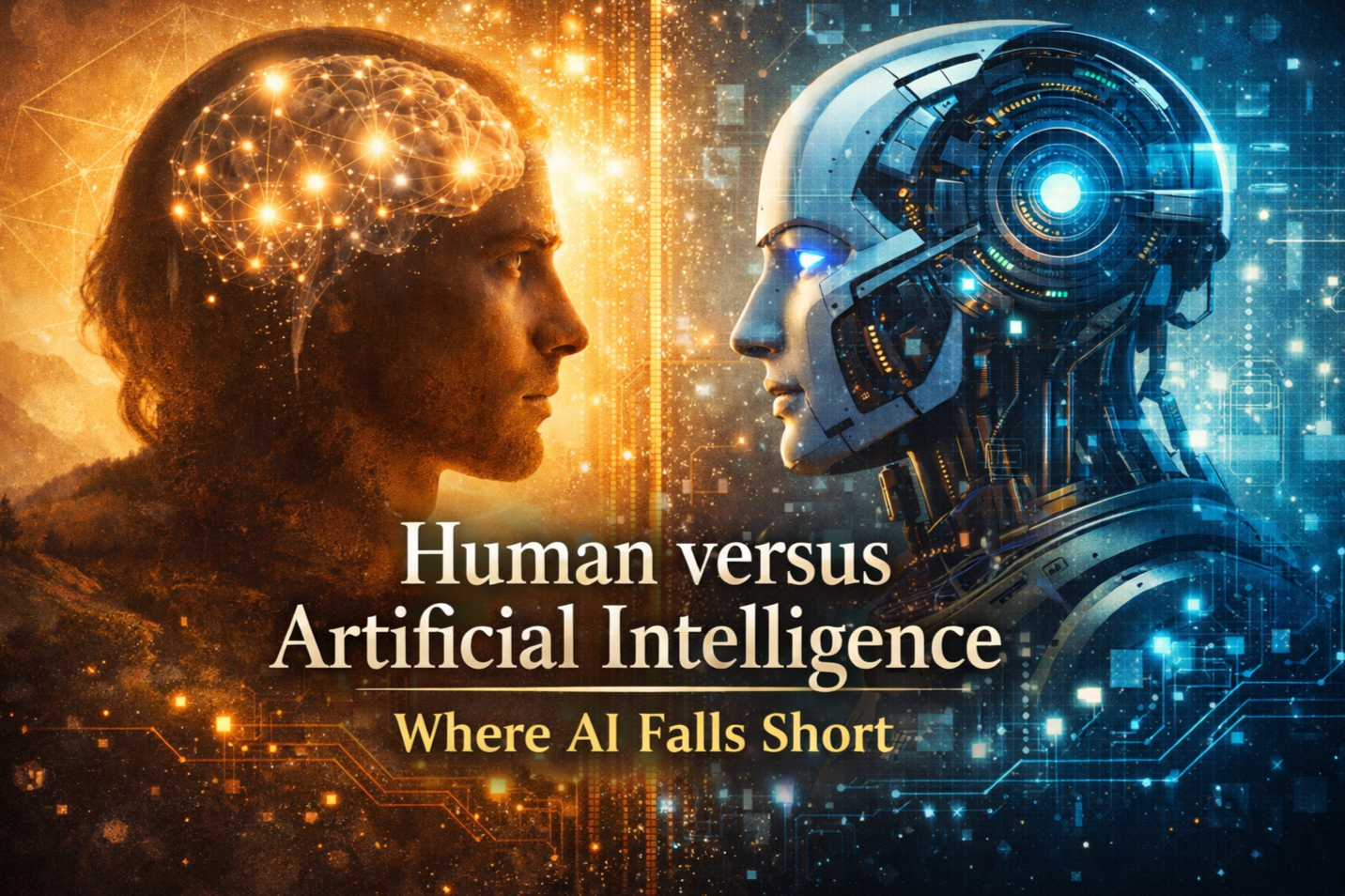
Artificial intelligence is advancing at an extraordinary pace.
It can process information faster than any human, recognise patterns across vast datasets, and generate language with remarkable coherence. In certain domains—particularly cognition—it is already surpassing human capability (Bubeck et al., 2023; Russell & Norvig, 2021).
There is no doubt this will reshape society in profound ways. And yet, this raises an important question:
What kind of intelligence is AI actually expressing—and how does that compare to the full spectrum of human intelligence?
To explore this, it helps to look at an older model of the human being—one that sees intelligence as layered, not singular.
In the yogic sciences, the human being is understood as five interpenetrating layers (Radhakrishnan, 1994).
⸻
1. Annamaya Kosha — The Physical Body
This is the only layer AI can even begin to simulate.
Biology
Brain activity
Nervous system
AI can mimic outputs that resemble this layer (language, logic), but it has no body, no metabolism, no mortality.
And already, something essential is missing.
⸻
2. Pranamaya Kosha — The Energy Body
This is where the argument begins to deepen.
Breath
Vitality
Life-force (prana)
Felt aliveness
A human being doesn’t just process information—we radiate presence (Siegel, 2012).
Two people can say the same words, yet one lands and one doesn’t.
Why? Because of energy.
AI has no energetic field. No charge. No transmission.
It cannot feel alive, and therefore cannot transmit aliveness.
⸻
3. Manomaya Kosha — The Mental & Emotional Field
This includes both cognition and feeling:
Thoughts and reasoning
Language and interpretation
Emotions
Inner narratives
Psychological patterns
This is the layer AI most closely replicates—particularly the cognitive dimension:
language
logic
pattern recognition
But even here, it only simulates the content of mind, not the experience of mind (Damasio, 1999).
It does not:
Feel heartbreak
Experience longing
Carry trauma
Transform through suffering
A human being doesn’t just describe love.
We are changed by it.
⸻
4. Vijnanamaya Kosha — The Wisdom Body
This is discernment, intuition, deep knowing.
Insight
Moral intelligence
Inner guidance
Meaning-making
AI operates on pattern recognition.
Humans operate on consciousness encountering itself. Wisdom is not just data—it is lived integration (Jung, 1968).
It emerges through:
contradiction
paradox
embodiment
AI does not become wise. It only aggregates and predicts.
⸻
5. Anandamaya Kosha — The Bliss / Soul Layer
This is the layer AI does not access.
Presence
Unity
Love as a state of being
Transpersonal awareness
This is where:
meditation opens
love dissolves the self
meaning becomes sacred
AI has no access to:
Being
Awareness
Soul
It cannot experience oneness, because it is not conscious (Chalmers, 1995).
⸻
Conclusion
AI may eventually replicate aspects of the outer layers of the human experience—but it has no access to the inner architecture of being.
AI can simulate intelligence. But it cannot simulate aliveness.
Modern culture equates intelligence with:
cognition
speed
information
But the koshas reveal intelligence is multi-dimensional:
biological
energetic
mental (cognitive + emotional)
intuitive
spiritual (Feuerstein, 2001)
AI occupies one band of that spectrum—and may even outperform humans within it.
But human beings are the whole spectrum.
⸻
References
Bubeck, S., et al. (2023). Sparks of Artificial General Intelligence: Early experiments with GPT-4. Microsoft Research.
Chalmers, D. J. (1995). Facing up to the problem of consciousness. Journal of Consciousness Studies, 2(3), 200–219.
Damasio, A. (1999). The Feeling of What Happens: Body and Emotion in the Making of Consciousness. Harcourt.
Feuerstein, G. (2001). The Yoga Tradition: Its History, Literature, Philosophy and Practice. Hohm Press.
Jung, C. G. (1968). The Archetypes and the Collective Unconscious. Princeton University Press.
Radhakrishnan, S. (1994). The Principal Upanishads. HarperCollins.
Russell, S., & Norvig, P. (2021). Artificial Intelligence: A Modern Approach (4th ed.). Pearson.
Siegel, D. J. (2012). The Developing Mind (2nd ed.). Guilford Press.