
The Bridging Polarity Method
A Transformational Framework for the Integration of Opposites
For therapists, practitioners, coaches and serious seekers interested in resolving conflict through the practice of integrating opposites.
The Bridging Polarity Method is my signature offering designed to turn polarisation into integration across the psychological, somatic, relational, and transpersonal dimensions of the human experience.
Developed through decades of clinical practice, formal training, and lived experience, this architecture provides structured map to resolve conflict through three axes, six polarities, six shadows, and six practices.

The Origins of Polarity
Throughout history, the world’s greatest healing and wisdom traditions have recognised a singular truth:
Growth does not occur by choosing one side over another, but by holding the tension of opposites.
When this tension is unresolved, we fall into polarisation — internal fragmentation, relational friction, professional stagnation. When the tension is properly held, we move towards integration.
Taoism — the dynamic movement of Yin and Yang reflects the integration of letting go and taking action.
Tantra — the union of Shiva and Shakti represent the integration of awareness and embodiment.
Jungian psychology — integration is the union of our inner masculine (Animus) and inner feminine (Anima).
Psychodynamic psychology — the tension between attachment (connection) and autonomy (boundary) is the key to interdependence and integration.
Hermeticism — the law of polarity postulates that opposites are not actually differences in kind but rather, differences in degree — resulting in an integrated spectrum.
Somatic therapies — regulation and activation form complementary physiological opposites.
Humanistic approaches — acceptance and growth, or vulnerability and agency, exist in creative tension.
Gestalt therapy — the whole emerges through parts integration and the relationship between Figure and Ground.
Alchemical symbolism — transformation unfolds through the integration of opposite forces, such as fire and water, or air and earth.
Though expressed differently, these traditions share the same essential architecture: transformation and growth takes place through the integration of opposites. This does not mean the polarities are taken away or made flat, but rather, they come into conscious relationship and flourish together.
How This Work Relates to Other Traditions
The Bridging Polarity Method synthesises the wisdom of the East with the clinical rigour of the West.
Taoism clarifies the active and receptive. Tantra unifies awareness (consciousness) and embodiment (energy). Jung maps out the symbolic shadow, and psychodynamic theory develops the relational dynamic between boundary and connection.
This framework organises their strengths into a unified three-axis architecture for resolving the polarisations that hold us back from our potential. By integrating the vertical (awareness / embodiment), horizontal (active / receptive) and circular (boundary / connection) axes, it provides a coherent structure for psychological, somatic, relational and transpersonal transformation.
The Core Axes: From Conflict to Coherence
Rather than treating polarity as an abstract theory, this method invites you into direct relationship with three fundamental tensions that shape our reality:
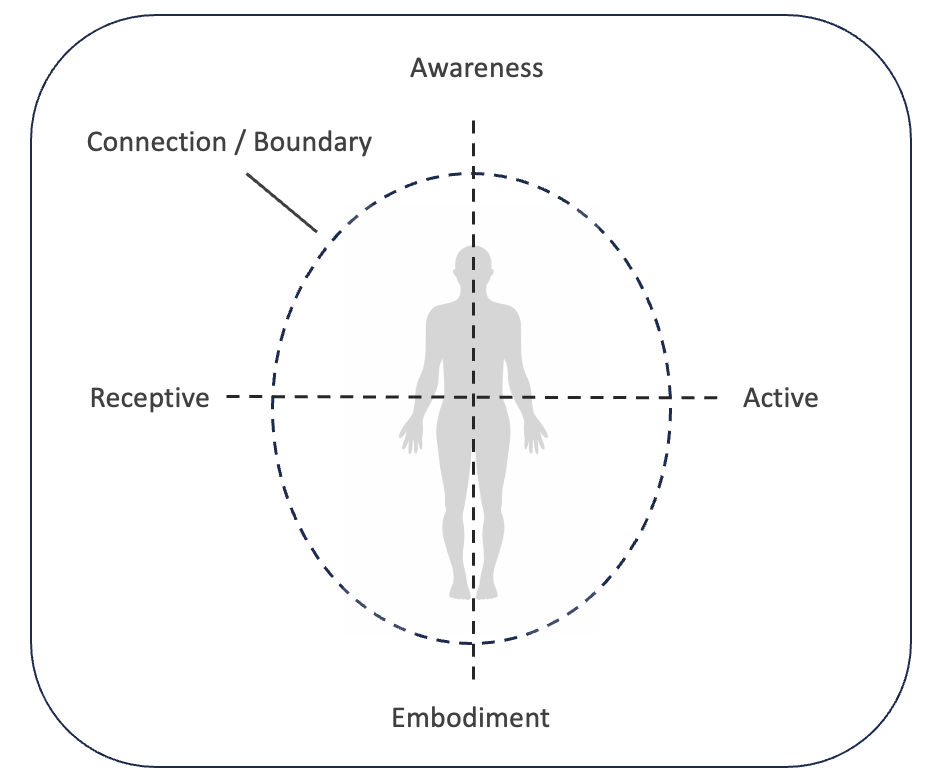
Awareness / Embodiment — The balance between perspective and participation, stillness and movement, along the vertical axis. This resolves the tension between “being stuck in the head” and “being overwhelmed by the body”.
Active / Receptive — The harmony between giving and receiving, taking action and letting go, along the horizontal axis. This resolving the tension between “forcing results” and “passive withdrawal”.
Boundary / Connection — The integrity between knowing when to close and open, separate and merge, along the circular axis. This resolves the polarisation between “being closed off” and “enmeshed”.
Each axis represents a vital tension of opposites. Working with them enables you to stop being ruled by internal and external divisions and begin to live, relate and contribute from your centre.
The Benefits of Integration
When polarities integrate, tangible changes occur — internally, relationally and professionally.
Clients report increases in:
Inner Stability — A secure base that remains steady under pressure.
Authentic Authority— The ability to lead and relate from a place of integrity and truth.
Relational flow — Moving from reactive conflict to conscious collaboration.
Meaningful Impact — A deep sense of fulfilment and contribution.
Mastery — The capacity to deliver and trust in life’s unfolding.
The Bridging Polarity Method is not about fixing what is broken, but integrating what has become divided. The changes are not peak states, but stable capacities that deepen over time.
An Invitation
The Bridging Polarity Method is not a belief system. It is a structured practice of becoming whole.
This work does not promise a life without tension. It offers something more meaningful: the capacity to master the tension of opposites. As opposites are brought into relationship, inner conflict softens, relational patterns begin to flow, and life begins to unfold with greater depth and fulfilment.
If you would like to explore the full architecture of the method, the White Paper is available below.
